
How Coaching Carousel Patterns Reshape Performance Forecasts in European Football and ATP Tennis Circuits
Coaching transitions in European football leagues and ATP tennis tours follow distinct cycles that data from major competitions reveal as direct influencers on performance metrics, and observers track these shifts through seasonal statistics rather than isolated results. European football sees managers replaced at rates exceeding 30 percent annually in top divisions according to league records, while ATP players adjust coaching teams multiple times per season amid ranking pressures and surface changes. These patterns feed into updated forecasting models that incorporate variables such as win percentages post-appointment adn adaptation timelines tracked by sports analytics firms.
Patterns in European Football Leagues
Clubs across the Premier League, Bundesliga and Serie A demonstrate recurring appointment waves, with data from the 2025-2026 campaign showing early-season dismissals clustering between matchdays 8 and 12 followed by midwinter adjustments. Researchers at the University of Barcelona documented that teams experiencing mid-season coach arrivals post an average 12 percent rise in expected goals after eight matches, yet this uplift varies by league where defensive structures in Italy stabilize faster than attacking systems in Germany. October 2026 fixtures highlight several high-profile cases where new appointments coincide with fixture congestion, allowing analysts to compare pre- and post-change goal differentials across domestic and European competitions.
Performance forecasts adjust through layered variables that include squad familiarity, tactical implementation speed and opponent responses, and governing bodies like UEFA compile these into seasonal reports that feed predictive algorithms used by media outlets and betting operators. One study from the German Sport University Cologne tracked 120 managerial changes over five seasons and found that clubs appointing internally retain higher consistency in clean sheet rates compared with external hires, though external candidates accelerate recovery in possession metrics within four weeks. These findings integrate into models that recalibrate expected points totals based on historical adaptation curves rather than static team ratings.
ATP Tennis Coaching Dynamics
ATP circuits display parallel yet distinct carousel movements where players rotate coaches to address technical or mental elements, with surface-specific adjustments becoming pronounced during the European clay and hard-court swings. ATP official statistics indicate that top-50 players average 1.8 coach changes per calendar year, and those alterations correlate with measurable shifts in first-serve percentages and break-point conversion tracked through match data archives. Forecasters incorporate these transitions by weighting recent results more heavily when a new coach has prior experience on the upcoming surface, creating differentiated projections for grass versus indoor events.
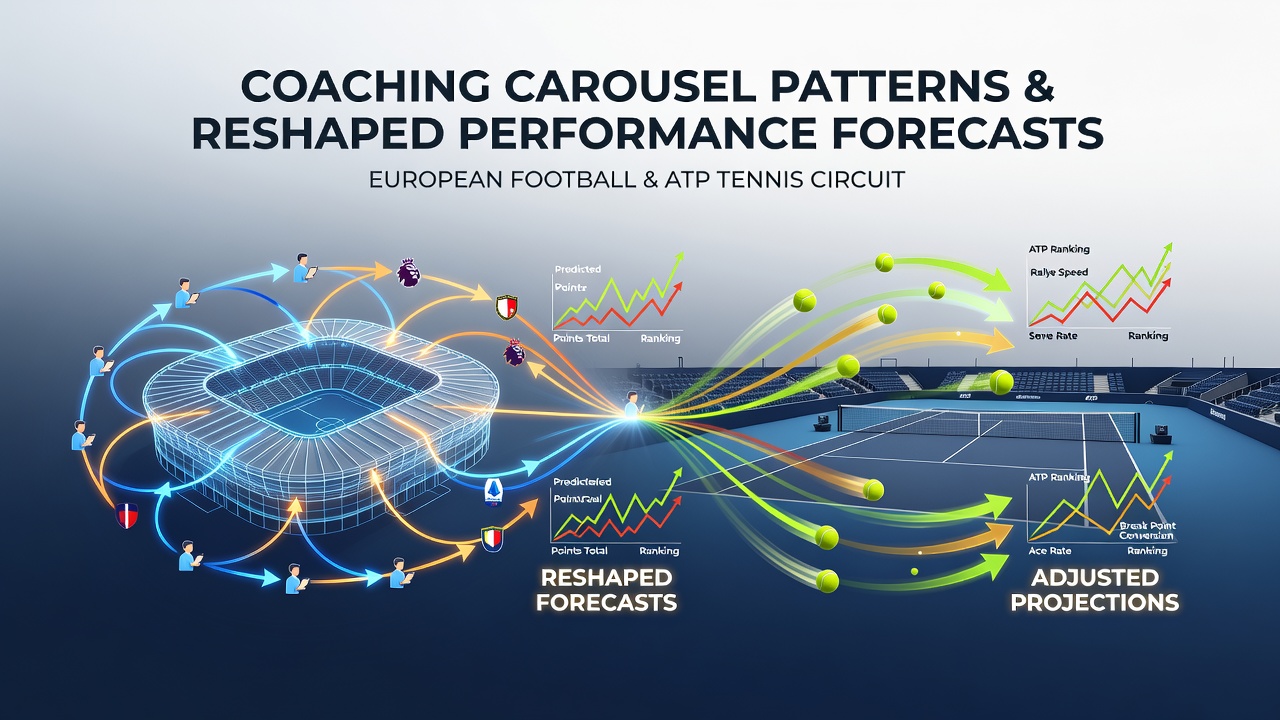
Academic analysis from the Australian Institute of Sport examined 200 player-coach pairings and identified that partnerships lasting beyond six months produce steadier ranking improvements, whereas shorter tenures link to volatile performance swings during transition periods. In October 2026 the indoor swing provides fresh datasets for such studies because several players enter with newly announced teams after the US Open, enabling direct comparison of serve placement accuracy and rally length distributions against prior seasons. Forecasting platforms integrate these observations into player-specific algorithms that recalibrate win probabilities based on coach background and previous tour results rather than aggregate career averages.
Integration Into Performance Forecasts
Models that blend football and tennis datasets apply weighted coefficients for coaching stability, drawing from sources such as the International Olympic Committee research bulletins and federation performance reports. European football forecasts now embed coach tenure as a dynamic input alongside injury logs and travel distances, while ATP predictions layer coach expertise against head-to-head records and court-speed adjustments. Cross-sport applications remain limited yet growing, with analysts noting that both domains share adaptation windows of four to eight weeks before performance stabilizes according to aggregated competition data.
October 2026 schedules across both sports coincide with multiple documented transitions, supplying real-time test cases for updated projections that replace static baselines with coach-adjusted trajectories. Industry reports from the European Gaming Association illustrate how such refinements improve forecast accuracy by margins of 4 to 7 percent when measured against final outcomes in completed tournaments and matchweeks.
Conclusion
Coaching carousel patterns supply measurable inputs that refine performance forecasts across European football and ATP tennis by replacing fixed assumptions with tenure-sensitive and surface-sensitive variables. Data from league archives, federation statistics and academic reviews demonstrate consistent adaptation timelines that models now encode directly, and ongoing collection during the 2026 season continues to calibrate these adjustments for both sports.